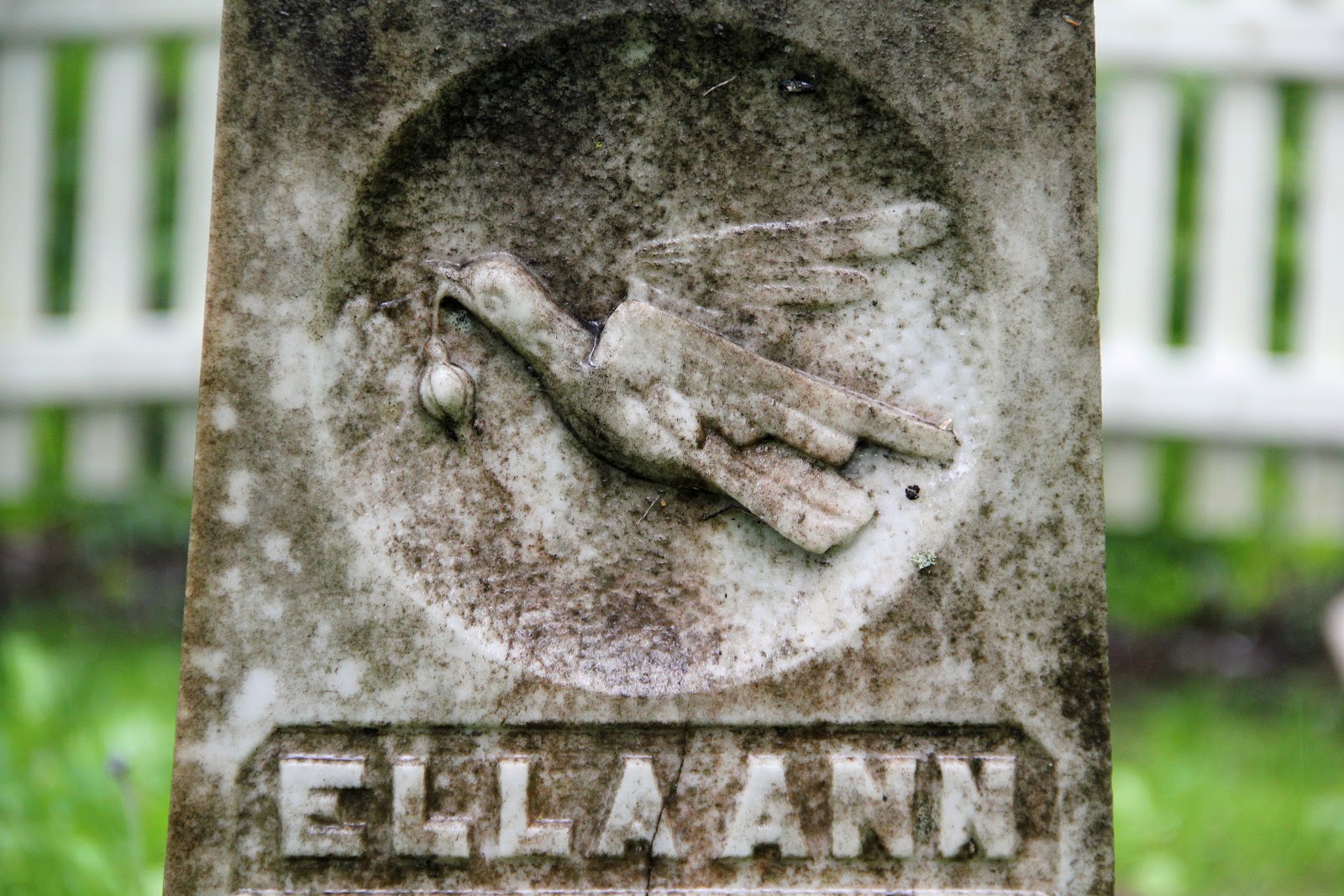
Most people know what an epitaph is, right? Those final
thoughts about a person lovingly etched into the bottom of
a stone. But, if I asked you what an EPITHET was, would
you know the answer?
What we put on gravestones today greatly differs from what was put
on them in the 18'th and 19'th centuries. There were
titles and words used that many of us have no idea the meaning of
today. For instance, there are terms used for a wife that many
people are quite unsure of and many times actually offended by.
If you know the meaning of each term, you will realize they simply
refer to the order in which the wife died in relationship
to her husband.
The first is
RELICT. This is a term
meaning widow; the husband had died before his wife.

The
other frequently used term is
CONSORT. This is the
one that causes such grief and confusion! It may not even be uncommon
for a husband to have two or three consorts all buried next to one
another. The term consort simply means that the wife died before the
husband, many times in childbirth. Often, men remarried
quickly in order to supply their children with a new caretaker. It
wasn't even terribly unusual to remarry the sister of a lost
wife.
 |
| Note: the word often looks as though it is spelled Confort.
This is due to the colonial s character
|
THERE ARE SEVEN BASIC PARTS TO AN INSCRIPTION.
Not every stone will include all seven, but many do.
1. the Header - Here Lyes, In the Memory
of, Sacred, The Mortal Remains of, etc…
2. the Epithet(s) – Daughter of, Honored,
Rev[erend], Christian, Esq[uire], Faithful Relict, Mason, etc…
3. the Name - Self explanitory. (although, it can
be amusing to pay attention to the older ones.)
4. the Formula of Death – Who fell victim
to, Departed this life, Died, etc…
5. the Date - Nov 21, 1851, ye Jan 15,
1779, etc…
6. the Age - Aetatis 49, Age 6months and 3
days, etc…
7. the Eulogies – A Biblical verse, Rest
in Peace, May his soul be rewarded, etc… (also sometimes referred to as the Epithaph)

I am always amazed when I find the reason for death listed clearly on a stone. As you can see here, on the stone for this 3 yr old child.
"His death was occasioned by the kick of a horse"
Also very touching is to find a formula of death written as this one was...
"Fell asleep..."
Now that you know all 7 elements, are you ready for a quiz?
Here are a few examples on stones here in Maine. See if you can
correctly name all the elements on Stone #1. ( Don't worry I'll provide the answers for #2 )
How did you do? That was a lot of information, wasn't it?
Here are the answers for stone #2
Here lyes dissolving in earth the mortal remains of =
Header
Mrs. Anne Storer = Name
Wife of = Epithet
Whose fair form fell a victim to death = Formula
of Death
the 3 day of Nov 1788 = Date
Having lived 25 years and 6 days = Age
————————————
Stone #2 had no Eulogy / Epitaph. Stone #1 does and I think it is
a very interesting perspective on life at that time, it reads…
"Her life was short her days were few but wisdom was to
her for gray hairs."
Now you have a good understanding of the parts to a gravestone
inscription. Time to grab a camera and a notebook to write down a few good
Epitaphs. You may be able to find one of my favorites
"Passerby cast an eye,
As you are now so once was I,
As I am now so you will be,
Prepare for Death and follow me."
Take advantage of the good weather so you can get out
there and see some of them for yourself!