Showing posts with label Taphophile. Show all posts

Monday, February 3, 2014

The Anchor Cross


Is this an anchor or is it a cross? The answer, it is both. Not only is it both, it is a truly ancient Christian symbol.


So why did Christians think to combine the two? The anchor has long been seen as a symbol of hope and faith. Going to sea was a terribly dangerous thing to do and many never returned. It was a leap of Faith just to venture out. There have been many times in history when Christians have been persecuted, this particular symbol became their secret declaration of faith.

One of the first examples of the creation of this symbol can be found around 100 A.D. The emperor Trajan banished the fourth pope, St. Clement, to the Crimea. When the pope converted the people there, Trajan ordered that Clement be tied to an iron anchor and drowned. Tradition holds that the sea then receded three miles to reveal Clement's body buried by angels in a marble mausoleum. Whether all the details of this tale are exactly true or not, but the story of Clement's martyrdom clearly inspired the persecuted Church.

During the Roman Empire Christians were terribly persecuted. Even fed to lions as entertainment.

The Roman Emperor Constantine (306-337) actually converted to Christianity. The cross replaced the anchor as a source of encouragement to believers in troubled waters. It was no longer needed by Christians to secretly identify themselves, as now the Empire formally embraced the religion.

Other scholars, though, think the anchor slipped from use because the "symbol" was actually a word play in Greek—ankura resembling en kurio, or "in the Lord"—which disappeared as Christians chose Latin over Greek as their primary language.

 The anchor did reappear in the 1600s, when it experienced a two-century renaissance, particularly as a symbol engraved on tombs.


Today if you search, you can still find this ancient cross used on tombs. Now you know what it means.


Tuesday, January 21, 2014

"Americans" only need apply. Nativists organization symbols in the cemetery.


This is a Masonic symbol right?    Wrong.

 
 This is a Masonic symbol. 

The ritual and symbology of the above symbol featured was said to be heavily influenced by that of the Freemasons. This is where the misidentification comes in.   Of the twenty five original founders, four were Freemasons and four other delegates were eventually raised to the Craft. The emblem of the Order incorporated the square and compasses with an arm and hammer in the middle. 


But  what was this group and what was their purpose?                                                           

What you see featured at the top, is the symbol for the Order of the United American Mechanics. This was an American Nativist organization - "American only". It originally was called the Union of Workers. Members were required to undertake efforts to publicize and campaign against the hiring of cheap foreign labor and to patronize only "American" businesses.

The Order grew out of the resentment many native born American workers in Philadelphia felt toward foreigners during the depression of the mid 1840s. As many American workers were laid off poor German immigrants were allegedly taking their jobs at lower wages.

Unlike other Nativist societies that sprang up in the 1840s and 1850, the OAUM was able to survive the Civil War. By 1896 there were State Councils in twenty one states and the order had 60,000 members.

In 1853 it created the Junior Order of United American Mechanics, as an youth auxiliary. This group would eventually become more popular than the OUAM itself and became an independent adult organization in 1885.

A stone featuring both OUAM & Masonic symbols.
 Overtime, the OUAM abandoned its Nativist politics and became a standard insurance society, even dropping the word "Order" from its name to become just the "United American Mechanics". It was eventually absorbed by its former youth affiliate, the Junior Order of United American Mechanics .

In 1903 the rules used by one Doylestown, Pennsylvania  group stated that membership was open to "white male citizens, born in the United States". The objects of the order were employment assistance, supporting member's businesses, assisting ill members, and providing funeral and survivor benefits. Meeting were each Wednesday evening. Dues were 15 cents a week. There were disability benefits of $5 for first 13 weeks, $4 next 13 weeks, and $3 onwards. Funeral benefits were $100, or for a spouse $50. Donations to distressed families were limited to a maximum of $2.

Thursday, January 2, 2014

Bastardized Symbols - their true meanings revealed.


One of the many aspects of being a taphophile is the study of icons and their secondary meanings when used on gravestones.  


We refer to this as IconographyWhile conducting cemetery tours, I explain to people what any given image on a stone says about the stone's owner. Many flora and fauna images used on stones have meanings speaking to faith, age or family relationships. It's a bit like reading hieroglyphics if you can speak the language.

 
 That being said, what would seeing a swastika on a gravestone say to you? What would it's secondary meaning be if not one of hate? And why would anyone use it? Read on for a quick history and the simple answer.

One thing we do know is that over time, the meaning of a symbol can change as changes in the culture also occur. Such is the case with the swastika.

We see this symbol as having a dark history. It's use is currently outlawed in Germany. All of this  can be attributed to one man's warped ambition, Adolf Hitler. In fact he hijacked not only this symbol but a second one as well during the days of the Third Reich.

A swastika plot marker from Texas.


The ironic thing is that this symbol can be traced back all the way to Roman times, and was also used by the Viking.

We can trace the use of the swastika cross well into antiquity.  It has been found on objects such as pottery and ancient coins from Gaza.  


 Some theorize that the symbol originated with the Pagans but was carried over into Christianity.

An early 1900's postcard sent for well wishes.
One thing we do know for sure, is that the word we use for it  "swastika", comes from the Sanskrit word svastika. It is derived from the  

su- meaning "good, well"  and

asti- "to be".... or svasti- thus meaning "well being"

The suffix -ka intensifies the the verbal meaning, so literal translation could then become "that which is associated with well being" or maybe even "lucky charm"

There is the answer, the secondary meaning.

Other names for the same symbol are many depending on the culture. It has been called the crooked cross, the angled cross, and the sun cross. In heraldry it is known as the cross cramponned due to each leg's resemblance to an iron-angle or a crampon. A Greek name for the symbol is the gammadion. Each leg of the cross resembles the gamma symbol. The use of this name can be found from Scotland to Iceland. The gammadion can be found on Celtic crosses and jewelry such as necklaces.

The swastika is also known as a gammadion cross.
Another found name for the cross is the Fylfot Cross [fil-fot]. In Britain the name fylfot came from the Anglo-Saxon's - fower fot, meaning "many footed". 

 A manuscript from the 1500's explains the use of the fylfot as a symbol to fill in the empty spaces at the bottom of stained glass windows in medieval churches.

As recently as June 12'th 1996, The British House of Commons Hastard Debate, discussed the badge of the No. 273 British Flight Squadron which uses the symbol. During the debate the ancient symbol was solely established as being called the fylfot while the Nazi symbol was to be referred to as the swastika. 

This firmly established "fylfot" as being the name of the "good" symbol. Even though the Nazi's had nothing to do with the creation of the swastika, their use of it has tainted it for all modern time.


A Christian grave featuring a Star of David.


Inevitably when one thinks of the Nazi's and their use of the swastika another symbol of that time period comes to mind.

 It is the Star of David. Also a very ancient symbol, this star has been used by Jews and Christians... yes Christians for hundreds of years.

It is formed of two triangles. One triangle being man and the other being God, the symbol represents the relationship between the two.  It is also said that the six points of the Star symbol represent all the directions within the Universe, North, South, East, West, up and down.

It was during WWII when Hilter again took control of yet another iconic faith symbol. He chose the Star of David gave it the color yellow and began to use it to "mark" all Jews.
"JEW" embroidered on a patch worn in WWII

Before this action, the Star of David was a minor Jewish symbol of faith, having equal significance with other similar faith symbols. By the end of the War, the world had witnessed the murder of six million people, many of them wearing this same small fabric star. Sadly the Star of David had forever cemented it's place in history as the absolute symbol of the Jewish people.


Fair or not, the meanings of both of these symbols have been forever altered by just one man. Certain images flash through the mind.


To place a Fylfot Cross in your window or mail postcards to your friends wishing them the power of the symbol would cause shock and inevitable scorn. Beautiful ancient symbols altered by Geo-politics. 

That being said, there was a time when these greetings would have been appreciated. 

This powerful final image, shows both symbols married together in stone forever.  Not in opposition, but complimenting each other.

In this age, who could ever have imagined such a sight?


Friday, December 20, 2013

Exhuming the Dead. Warning: images may be disturbing to some people.


The exhumation of graves is never something done on a whim. The process, if done correctly, is a careful and meticulously documented endeavor. Not just the moving of stones...


This blog will walk you, the reader, through the exhumation process of an entire family that was conducted in Rochester, N.H.

The site of the original Legro Cemetery and exhumations.
Plastic was used to preserve the area. 
During the fall of 2009, an archaeologist on a state-sponsored excavation project for the NH Highway Department, exhumed the remains within the Legro and Leighton cemetery which was located in middle of the on/off ramp of Exit 15 off the Spaulding Turnpike in Rochester, NH. The removal of the cemetery was to make way for the new highway ramps.


Years before the exhumation project all of the headstones had been removed from the cemetery, for what was called "safe keeping" by a local cemetery enthusiast. This person made a hand written map, using tree locations as measurements to mark where the headstone once stood. This ultimately posed a huge challenge for the archeological team since some of the trees had been removed since the making of the map. The true size of the family cemetery and position that the markers had been in were now not properly documented. It would be a game of guess work to locate exact positioning for all of the remains. All this extra work for the team, due to the actions of a person who wanted to "help".


Carefully removing soil from the remains.
Elihu Legro's remains

The workers started their day at 7 am and worked through the day until 5 pm.


Most of the team's day was spent bent over on their knees in the dirt performing painstaking work. This made for very long days.  


At the end of their work day the workers would secure their tools, stretch plastic sheeting over the site and secure them with sandbags.


A tractor would then bring in large sheets of metal to be laid on top to keep anyone from tampering with the site. 


The team typically didn't work past 5 pm unless they found new remains, then they all concentrated their time on quickly and carefully exhuming and documenting the newest finds before it became too dark. 


A Leighton Child

Pieces of glass were found on top of some of the children's skulls, this would have allowed for a closed casket funeral where the child's face was visible. These coffins were known as a viewing coffins. The glass had the unintended consequence of creating a "microenvironment" that allowed for better preservation of some of the remains. The children's remains are from the 1840s or '50s, while the adults may have been buried as late as 1871.


One of the many great finds was the original headstone that belonged to Elihu which was thought to have been removed to make way for his Civil War Military stone. 

It was buried under 8 inches of soil and three feet from his resting place.


Mary Legro remains. Notice the hairpin used to hold her hair back is still present on the skull.

Researchers found elaborate buttons near the remains of Mary Legro. Also present was a hair pin and a frock button which would have been a part of her dress.


A collection of burial artifacts including buttons, nails and a coffin handle.

The whole process took approximately two weeks to complete.


The final archeological report showed the Legro Cemetery measured 25 rods and contained the remains of David and Joanna Legro, Elihu and Mary Legro, their son Elihu Jr., 2 of  Elihu’s siblings, as well as four children from the Leighton Family.


On May 8th 2010 under rainy skies, Elihu Legro a Civil War veteran was reburied with full military honors at the Rochester Cemetery.
 

Small handmade pine caskets.


Prior to Elihu's burial, the rest of the family was reburied.


All were reburied in the same order they were found in. 


All were given new handmade caskets as seen in this photo to the right.


Pine caskets placed in eco-vaults.


As you can see, this was a massive undertaking.  Not just a quick shuffling of gravestones from one location to another. Officials from the governor's office to state and local government agencies were involved.


Daniel Meehan a Son's of Union Veteran's official and a Civil War reinactor with the 12th New Hampshire single-handedly orchestrated the entire funeral.

Final Footnote:


It was noticed that Elihu's and Mary's heads were tipped to the sides. The result was that each was  looking at the other.


Prior to being placed within their newly made coffins, straw was laid down and they were placed the same exact way, so they will continue to look at each other through the ages.

May they finally rest in peace.


This photo shows how they were found.


Tuesday, August 6, 2013

Thyme, the herb of Death


While walking through a very old garden cemetery, I happened to noticed for the first time, a very steep embankment that was covered in something that was clearly not grass. Little purple blossoms were peeking out here and there in bunches within the massive green carpet of the stuff. My friend who is an avid landscaper told me to pick a bit of the green ground cover and crush it between my fingers.

Instantly I recognized the pungent aroma from stews and stuffings that I have made countless times in my own kitchen. There was no doubt, it was Thyme. 


She told me that thyme was a common plant to be found growing unchecked in the oldest of cemeteries. THIS fact, I had never heard of. I was intrigued. She went on to tell me that this fragrant little herb was commonly planted in cemeteries of antiquity to mask.... well, odours.

I had to know more about this so I did a little research and was shocked at the many uses of thyme and it's long and close association with death.


Wild or creeping thyme or Thymus Serpyllum, a species of the mint family, has been used in death practices and various rituals all the way back to Ancient Egypt. The Egyptians used thyme in their embalming practices. The Greeks burnt thyme as an incense in their temples, believing it to be a source of courage. Roman soldiers, who may be away from home for long periods of time, slept on the herb to help them with melancholy.

The practice of sleeping on thyme can also be found in the Middle Ages when Europeans used sprigs of thyme under their pillows to ward off nightmares.


Teas made of thyme were promised to relieve ailments such as headaches and hangovers.

It was also encouraged to plant thyme for the bees as it was said to fortify them.


Patches of thyme were even set aside by gardeners who thought them to be inhabited by fairies.


 Due to it's fragrant aroma, thyme along with lavender, was sprinkled on the floors of churches to purify the air. For those of you who aren't aware... long ago, people were once buried under the floors of churches and well, with no Lysol around. You get the picture.

Thyme has been burnt as a purifying incense for as long as sage has.  It has also long been placed into coffins during funerals. This practice was thought to help insure the departed one's passage into the next life.

Members of the Fraternal Order of Odd fellows carry sprigs of thyme during their funeral rites. They ceremonially throw the herb into the open grave of their passed members.

 The practice of planting creeping thyme in cemeteries can be found beginning in Wales. This made sense to me since I realized that some of the earliest slate stones in New England were imported on ships from Wales. The Island of Wales has long been known for it's thriving slate industry. My mind made the instant connection, if settlers were bringing over stones the knew well for carving, maybe they were bringing other bits of cemetery tradition with them as well... fragrant, spreading thyme plants

Some British citizens hold to an age old death superstition dealing with thyme... 


It is thought that bringing thyme sprigs into a house will also bring death or illness to a family member within that house.

 Thyme is also said to be a phantom scent common with haunted locations.

Today, thyme may be a common herb found in the household spice rack but this noble herb has quite an interesting list of uncommon uses and a mystical, almost magical wealth of folklore attached to it.


Thursday, July 25, 2013

the Long S


Have you ever walked through a very old cemetery and become confused as to what a stone was trying to say? Or looked at an epitaph and wondered why in the world a letter -f- was used in place of an -s-?  If so, you have witnessed first hand the confusing use of the long s.

The word pass appears as pafs and wise looks like the word wife.

For years I have wondered about this character in Colonial script. Why did they use this -f- letter... and what were the rules dictating it's use? Some words had it, others didn't... some words that contained double -s- had both the -f- like letter and a normal -s-.  I asked teachers and historians alike but with no suitable answer to my question. Everyone had the same answer... "I'm not sure."

The problem was... neither were the Colonists who etched it into their memorials and that's the reason it's not used today.


Let me explain:

What you are looking at is referred to as the long, medial or descending letter s represented by what looks like a lower case f.

The true lower case s we are accustomed to using today is referred to as the short, round or terminal s.

From here on I will make reference to long and short s forms.

The long s came from early Roman cursive. After dying out, it was picked up again in usage sometime in 1400's by Italian printers. It was quite a fashionable trend. The long s also came in 2 forms, with and without a nub. When appearing, the nub is always placed to the left of the letter.

It wasn't used exclusively by the Italians though, the Germans also used this character in Blackletter typeface.

Here are some of the complicated rules on how to use this letter:


When a font containing long s is used, German typographic rules require the short s to be used when it occurs singly at the end of a syllable, while long s is used at the beginning of a syllable.  The short s appears at the end of each word within a compound word. This is why some call it the terminal s - it comes at the end. Where as the long s comes in the middle and is sometimes called medial s.

Confused yet? 
Yes, and so were most people!
 
These rules were broken all the time.

 Notice the last two pictures on the left. They belong to a husband and wife, both were carved within about 10 years of each other. Sarah's stone makes reference to her husband - Joseph - using a short s. While on Mr. Belknap's stone his name is spelled out with a longs s. Same name two different usages of the s.


  The use of any typeface using the long s fell out of favor in the US and Britain within the early 19'th century about 1810, although handwritten samples can be found into the 1860's. It is said that confusion and even those suffering from poor vision, all led to the demise of this font trend. In a population that wasn't terribly literate, it was just too complicated.


Today those who use the long s do so to catch the eye only.  It's modern use is as buried as the Colonials who so long ago etched it into stone.


Wednesday, July 10, 2013

Taphophile Corner - Displaced Honor


Over the years as I make my way through cemeteries gathering Civil War veterans burial information, I have noticed a common occurrence, one of misplaced GAR flag markers. 


The GAR (Grand Army of the Republic) was an organization much like today’s American Legion and was made up of honorably discharged Union Veterans, not every veteran joined the GAR but those who were members would receive a flag holder for their grave so a flag could be placed for Decoration Day.

But as I make my way across states and cemeteries I see the same theme, that of these markers on the wrong graves, such as a child’s grave, that of a woman, on a man’s grave who was not even born during the Civil War and even propped up near a fence. 
Women were not permitted to be G.A.R. members

I have had the chance to talk to some cemetery groundskeepers who have told me that the markers are moved a lot of times so they can mow around a stone and then either forgotten about or misplaced.

 A person whose relative who fought in WWII needed a flag holder and this GAR marker on a grave seemed like a good holder, and even some cemeteries will help a person remove the marker to place elsewhere. 


The reasons are many of why they are removed and still some are removed and sold on Ebay,  

which is against Ebay policies. In some states it is against the law to even sell these.


One day I walked into a cemetery office and asked about the misplaced markers. I was told that they had no idea of what to do and for me to just fix it if I like…WHAT!!! Ok, so I can just remove any grave marker??? I know there were laws protecting grave markers. What about cemetery rules??? 

Born after the Civil War - could not have earned a G.A.R. marker

Before removing a marker you need permission from the cemetery commission and from a relative of the person whose grave it is on. That can take a long time and research.


But I am starting to notice that this trend is now not being limited to just the GAR markers but is also effecting other veterans from other wars. It is sad that these men and woman who gave so much and asked so little can not even keep a simple flag holding to honor them, just because someone is too lazy to buy their own or to replace it correctly after mowing.

One day I was talking with a member of an American Legion and he asked me to ID an item. He showed me a GAR Marker, I explained to him what it was and the organization. He told me that the Legion Post had a 55-gallon barrel full of them and they were going to scrap them because they didn’t know what they were. I took them all and have since replaced them back into their local cemetery.


 I am a believer also that the correct marker should be placed at the correct grave, GAR or Civil War Vet for Civil War Veterans, Span Am for Spanish American Veterans, WWII Markers for WWII Vets.


I have been seeing VFW Markers for Civil War Veterans and this is a miss representation as there were no VFW’s around at that time and if you want to spend the time marking graves then it should be done with the right marker. 


A special Thank You to Daniel Meehan my guest blogger. 

Daniel has spent countless hours in the cemeteries of New Hampshire documenting Veteran's graves and compiling their photos and histories. Daniel is a War reinactor as well as a Veteran advocate. He was intricately involved in the moving and honorable re-interment of a Civil War Veteran and his family due to a construction project in his area. Daniel personally provides the flags to various cemeteries in his town since the VFW has refused to do so. He feels passionately about honoring the service of Veterans across the board and I believe, was the perfect person to speak on this topic.

Tuesday, June 26, 2012

the Siren's song


Siren Song  n. An enticing plea or appeal, especially one that is deceptively alluring.


The Cemetery and Mythology... not a combination one sees very frequently. That's why I was pretty excited to find the image above.

This is the stone was dated 1849 and belonged to a 53 yr old man. The cemetery is on the Coast of Maine and holds countless ship captains. There are images of anchors and boats of all kinds on various stones here. Stories of bravery and tragedy.


Could this be a grieving wife.... yes. It may even be the classic image of the Virtue - Faith.

But, this imagery makes me think it could be even more than that. The parted curtain symbolizes the entry into Heaven. The anchor, a strong symbol of a life on the Sea as well as that of Christian faith. The finger pointed upwards, yet another sign of the final reward.

Then there is the woman herself. The first thing that struck me was her long Lady Godiva style hair. A long flowing dress with what looks like bare arms.

This would have been irresistible imagery in the mid 19'th century. Is she not a wife but a temptress maybe?


So what exactly is a Siren?


Sirens were dangerous creatures who lured mariners with their beautiful music and enchanting voices to an untimely death.

They were considered the daughters of the river god Achelous. There were said to be between 2 and 5 of them existing off the islands of Greece. There are two Sirens referred to in Homer's tale the Odyssey. As well as more references in the Iliad.

Though these creatures are tied to the Sea, they are not sea maidens and are not to be confused with mermaids. In fact they are not fish-like at all.

The earliest Greek images portraying Sirens showed them as large birds with female faces. They sang like birds and were granted wings by Demeter.


This pottery portrays an interesting legend. 

It is said that Odysseus was curious as to what the Sirens sung in their song to him, so, on Circe's advice, he had all his sailors plug their ears with beeswax and tie him to the mast. He ordered his men to leave him tied tightly to the mast, no matter how much he would beg. When he heard their beautiful song, he ordered the sailors to untie him but they bound him tighter. When they had passed out of earshot, only then was Odysseus untied.


The depictions of Sirens have changed over time as they became less bird like and portrayed more as femmes fatales.

There have even been references to them as the muses of the underworld.

Descriptions are also found of them on the islands, "lolling there in their meadow, round them heaps of corpses rotting away, rags of skin shriveling on their bones."  Not your average maiden.


With all of the death in the 19'th century by men making their fortunes from the Sea, it is no wonder the legend of the Siren may still be found in the cemetery. Though it's origins are Greek, the Siren appears any place in the world where people feared for their lives and the unknown.  Even in a small cemetery off the coast of Maine.


Monday, June 18, 2012

the Obelisk


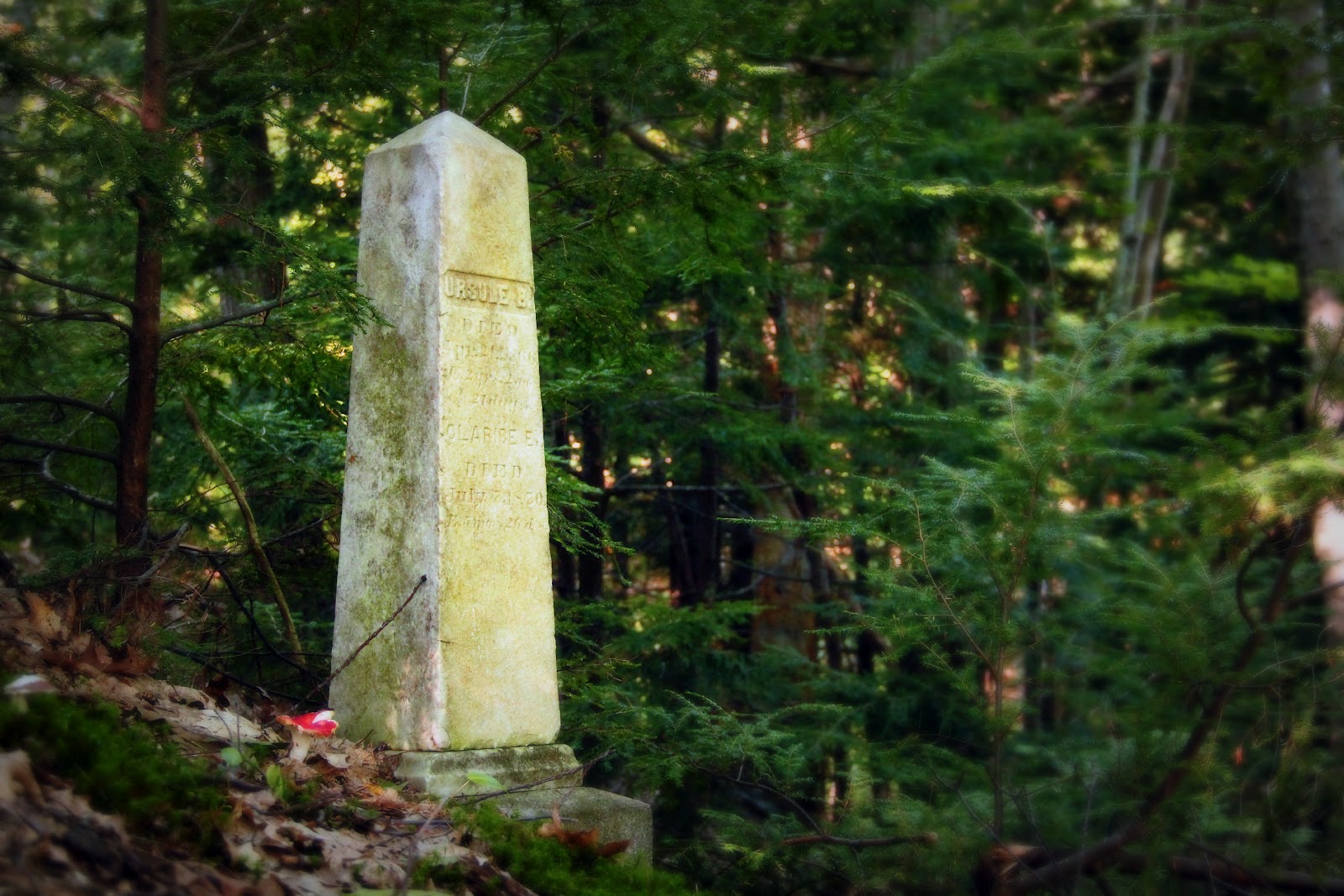
The obelisk is one of the most classic shapes in the cemetery. But did you ever wonder what inspired it's design?

Say obelisk and no doubt the Washington Monument in our Nation's capital comes to your mind. It's one of the most famous obelisks in the world. But this shape is also found everywhere in 19'th century cemeteries. Shapes are important in cemetery art... design always has meaning.

The answer can be found in Egypt.


The Egyptians were absolute masters in forming monuments and statues that would stand the test of time. Monuments dedicated to Pharaoh were commonly portrayed as sitting. All arms and legs were carved compactly situated to the bodies. Over the ages, there were no long outreaching arms to break off unlike many Greek statues. The compact Egyptian design held up beautifully over time. They truly mastered shapes that were meant to hold up.

A main deity in the Egyptian religious beliefs, was the sun god Ra. Life was seen to come from Ra but death was also connected. The dead were buried on the west side of the Nile where the sun was seen as dying each day. On the flip side, the living stayed strictly on the east side of the Nile... here the sun was daily reborn.

The obelisk shape is said to symbolize a ray of light, associated with Ra.  Also known as a light pillar or solar pillar. It's four cornered base is solid and thicker than it's top, allowing it to withstand more than a simple pillar. A light pillar is a visual phenomenon created by the reflection of light from ice crystals with near horizontal parallel planar surfaces. The light can come from the Sun (usually at or low to the horizon) in which case the phenomenon is called a sun pillar. It can also come from the Moon or other sources such as streetlights.


Did you know that the obsession that fueled the obelisk movement in America had a name?

The term "Egyptomania" was coined in part due to ... Napoleon?

Yes, we have Napoleon to thank for introducing America to the "All-Things-Egyptian Craze".  Napoleon's Egyptian Campaign from 1798-1801 introduced the world to Egypt and it's culture. In the early 1800's books were being published on Egypt and the fever began to spread rapidly. There wasn't a single piece of American culture that wasn't suddenly influenced by this new trend. This was seen especially in the cemetery.

After some time the obelisk also began to take on some variations. As we see in this photo to the side, they didn't always have a simple pyramid top. Some were topped with urns.

The urns are also of Egyptian origin - (the canopic jar)

Some had small angular roof peaks. We call these vaulted obelisks.

While others had crosses attached to the tops.


Even traditionally shaped stones, like this slate, added the obelisk image .


This truly massive obelisk towers at more than 30 feet high. A grand representation to a family's wealth and social status.


Some obelisks incorporated other traditional icons such as the classic willow or maybe a dove indicating a lost child. Multiple layers of meaning...


Hope you enjoyed this post and explanation.