Showing posts with label icons. Show all posts

Monday, February 3, 2014

The Anchor Cross


Is this an anchor or is it a cross? The answer, it is both. Not only is it both, it is a truly ancient Christian symbol.


So why did Christians think to combine the two? The anchor has long been seen as a symbol of hope and faith. Going to sea was a terribly dangerous thing to do and many never returned. It was a leap of Faith just to venture out. There have been many times in history when Christians have been persecuted, this particular symbol became their secret declaration of faith.

One of the first examples of the creation of this symbol can be found around 100 A.D. The emperor Trajan banished the fourth pope, St. Clement, to the Crimea. When the pope converted the people there, Trajan ordered that Clement be tied to an iron anchor and drowned. Tradition holds that the sea then receded three miles to reveal Clement's body buried by angels in a marble mausoleum. Whether all the details of this tale are exactly true or not, but the story of Clement's martyrdom clearly inspired the persecuted Church.

During the Roman Empire Christians were terribly persecuted. Even fed to lions as entertainment.

The Roman Emperor Constantine (306-337) actually converted to Christianity. The cross replaced the anchor as a source of encouragement to believers in troubled waters. It was no longer needed by Christians to secretly identify themselves, as now the Empire formally embraced the religion.

Other scholars, though, think the anchor slipped from use because the "symbol" was actually a word play in Greek—ankura resembling en kurio, or "in the Lord"—which disappeared as Christians chose Latin over Greek as their primary language.

 The anchor did reappear in the 1600s, when it experienced a two-century renaissance, particularly as a symbol engraved on tombs.


Today if you search, you can still find this ancient cross used on tombs. Now you know what it means.


Tuesday, January 21, 2014

"Americans" only need apply. Nativists organization symbols in the cemetery.


This is a Masonic symbol right?    Wrong.

 
 This is a Masonic symbol. 

The ritual and symbology of the above symbol featured was said to be heavily influenced by that of the Freemasons. This is where the misidentification comes in.   Of the twenty five original founders, four were Freemasons and four other delegates were eventually raised to the Craft. The emblem of the Order incorporated the square and compasses with an arm and hammer in the middle. 


But  what was this group and what was their purpose?                                                           

What you see featured at the top, is the symbol for the Order of the United American Mechanics. This was an American Nativist organization - "American only". It originally was called the Union of Workers. Members were required to undertake efforts to publicize and campaign against the hiring of cheap foreign labor and to patronize only "American" businesses.
The Order grew out of the resentment many native born American workers in Philadelphia felt toward foreigners during the depression of the mid 1840s. As many American workers were laid off poor German immigrants were allegedly taking their jobs at lower wages.

Unlike other Nativist societies that sprang up in the 1840s and 1850, the OAUM was able to survive the Civil War. By 1896 there were State Councils in twenty one states and the order had 60,000 members.

In 1853 it created the Junior Order of United American Mechanics, as an youth auxiliary. This group would eventually become more popular than the OUAM itself and became an independent adult organization in 1885.

A stone featuring both OUAM & Masonic symbols.
 Overtime, the OUAM abandoned its Nativist politics and became a standard insurance society, even dropping the word "Order" from its name to become just the "United American Mechanics". It was eventually absorbed by its former youth affiliate, the Junior Order of United American Mechanics .

In 1903 the rules used by one Doylestown, Pennsylvania  group stated that membership was open to "white male citizens, born in the United States". The objects of the order were employment assistance, supporting member's businesses, assisting ill members, and providing funeral and survivor benefits. Meeting were each Wednesday evening. Dues were 15 cents a week. There were disability benefits of $5 for first 13 weeks, $4 next 13 weeks, and $3 onwards. Funeral benefits were $100, or for a spouse $50. Donations to distressed families were limited to a maximum of $2.

Tuesday, August 20, 2013

the Claddagh


It's rare, but occasionally I stumble across this icon on a grave stone. It has to be one of the most romantic images I know of.  It's a symbol of love created in the small Galway fishing village of Claddagh. The word “Claddagh” comes from the Irish term An Cladach, meaning a flat, stony shore.


The parts of the symbol are broken down as so,
Two hands (friendship) cradling a heart (love) topped by a crown (loyalty).

Legends behind the claddagh are many but one stands out as a triumph of the power that true love can hold...

Richard Joyce, a native of the small fishing village, was captured by Algerian pirates and sold as a slave to a Moorish goldsmith. When William III of England demanded the release of all British subjects, Joyce, too, was released. Not wanting to lose a valuable and skilled apprentice, the Moorish goldsmith offered Joyce a major portion of his wealth and his daughter in marriage, if Joyce would stay on in Algiers. Joyce refused the tempting offer and returned to the village of Claddagh where he had left behind the woman he loved. Some legends say that each day Joyce took a tiny bit of gold and saved it till he had enough to form a ring. Other accounts say he designed the symbol upon his return to Ireland. Either way, the ring he made stood for eternal love and was given, with his heart, to the woman who waited for him at home.

How to wear the Claddagh


If the ring is worn on the right hand with the crown facing out ward, the heart is available and looking for love.
  If the crown is turned to face the wearer... love has been found and is being considered.

Once the ring has been transferred to the left hand, love has become eternal.


To find the Claddagh on a gravestone speaks to the love a couple shared in life and their promise to each other that not even death can take it from them.  

Seriously... is that romantic or what?

Thursday, August 8, 2013

How in the world did they come up with that? Military Edition

Have you ever wondered how some nicknames came about?  Why a delicate flower became the symbol of a very bloody conflict? Sometimes on the surface these things make no sense at all... until you hear the rest of the story. This blog will explain how certain military phrases, nicknames and symbols became part of our American consciousness.

Walking through most any American cemetery, one can see a collection of small metal markers near gravestones. These markers are meant to hold flags and typically reflect the symbols of the military branches and organizations that they represent.

Here I will explain a couple of the most seen.

World War 1 Marker depicting the “Poppy.” The red poppy has become a familiar emblem of Remembrance Day (November 11). Poppies bloomed in mass numbers across some of the worst battlefields of France during World War I. Their brilliant red color an appropriate symbol for the blood spilled in the war. Even today veterans groups can be found selling small paper "Buddy Poppies" to raise monies and awareness for their support programs.

There are many flowers in France... so why the poppy?

Doctor John McCrae, of Canada, serving as a military doctor is the reason.

It is believed that the death of Dr. McCrae's friend, Alexis Helmer, was the inspiration for McCrae's poem ‘In Flanders Fields’. The exact details of when the first draft was written may never be known because there are various accounts by those who were with McCrae at that time. Some say he wrote the poem in just 20 minutes in an effort to deal with his friends funeral, or that it was written on a work break in between groups of battlefield casualties.
    No matter HOW the poem came about... the fact that it was a highly emotional poem written right on the battlefield, greatly impacted all who read it. The imagery in the poem  'In Flanders Fields'  became the symbol of the War....


    In Flanders fields the poppies blow                                        
    Between the crosses, row on row,
    That mark our place; and in the sky
    The larks, still bravely singing, fly
    Scarce heard amid the guns below.

    We are the Dead. Short days ago
    We lived, felt dawn, saw sunset glow,
    Loved and were loved, and now we lie
             In Flanders fields.

    Take up our quarrel with the foe:
    To you from failing hands we throw
    The torch; be yours to hold it high.
    If ye break faith with us who die
    We shall not sleep, though poppies grow
             In Flanders fields.


    WWI also brought the term "Doughboy" into the American lexicon.


    Doughboys' was the nickname given to the American Expeditionary Force that took part in the later years of World War One. Before this decisive US involvement the name had applied only to infantryman, but at some point between April 1917 and November 1918 the word expanded to include the whole American armed forces. The term was not used in a derogatory sense, in fact it was a badge of honor, and is present in the diaries and letters of US serviceman, as well as newspapers.

    The actual origin of the term 'Doughboy' is still debated within both US historical and military circles, but it dates back to at least the American-Mexican War of 1846-7 after observers noticed U.S. infantry forces were constantly covered with chalky dust from marching through the dry terrain of northern Mexico, giving the men the appearance of unbaked dough. Another suggestion also arises from the Mexican–American War, and the dust-covered infantry men resembled the commonly used mud bricks of the area known as adobes. No one knows for sure the exact inspiration for the nickname but the fact remains that it was made very popular many years later during WWI. 

    Click on the link below to hear a hit song from the era using the term.
    Johnny Doughboy Found a Rose in Ireland

    Another strange nickname comes from WWII.

     "The Ruptured Duck" marker was originally  a cloth insignia depicting an eagle inside a wreath. WWII servicemen and women wore it on uniforms above the right breast pocket.

    It was issued to service personnel who were about to leave the military with an Honorable Discharge. It also allowed them to continue to wear their uniform for up to thirty days after they were discharged since there was a clothing shortage at that time. This showed the MP's that they were in transit and not AWOL. 


    Well, the boys thought the eagle looked more like a duck; and because it meant they were going home, the popular saying was, 

    "They took off like a Ruptured Duck"

    Kind of paints a funny picture, huh? But that's the true story. Ask any WWII veteran, they know the term well. 
    Written by guest blogger:  Daniel Meehan


    Tuesday, June 26, 2012

    the Siren's song


    Siren Song  n. An enticing plea or appeal, especially one that is deceptively alluring.


    The Cemetery and Mythology... not a combination one sees very frequently. That's why I was pretty excited to find the image above.

    This is the stone was dated 1849 and belonged to a 53 yr old man. The cemetery is on the Coast of Maine and holds countless ship captains. There are images of anchors and boats of all kinds on various stones here. Stories of bravery and tragedy.


    Could this be a grieving wife.... yes. It may even be the classic image of the Virtue - Faith.

    But, this imagery makes me think it could be even more than that. The parted curtain symbolizes the entry into Heaven. The anchor, a strong symbol of a life on the Sea as well as that of Christian faith. The finger pointed upwards, yet another sign of the final reward.

    Then there is the woman herself. The first thing that struck me was her long Lady Godiva style hair. A long flowing dress with what looks like bare arms.

    This would have been irresistible imagery in the mid 19'th century. Is she not a wife but a temptress maybe?


    So what exactly is a Siren?


    Sirens were dangerous creatures who lured mariners with their beautiful music and enchanting voices to an untimely death.

    They were considered the daughters of the river god Achelous. There were said to be between 2 and 5 of them existing off the islands of Greece. There are two Sirens referred to in Homer's tale the Odyssey. As well as more references in the Iliad.

    Though these creatures are tied to the Sea, they are not sea maidens and are not to be confused with mermaids. In fact they are not fish-like at all.

    The earliest Greek images portraying Sirens showed them as large birds with female faces. They sang like birds and were granted wings by Demeter.


    This pottery portrays an interesting legend. 

    It is said that Odysseus was curious as to what the Sirens sung in their song to him, so, on Circe's advice, he had all his sailors plug their ears with beeswax and tie him to the mast. He ordered his men to leave him tied tightly to the mast, no matter how much he would beg. When he heard their beautiful song, he ordered the sailors to untie him but they bound him tighter. When they had passed out of earshot, only then was Odysseus untied.


    The depictions of Sirens have changed over time as they became less bird like and portrayed more as femmes fatales.

    There have even been references to them as the muses of the underworld.

    Descriptions are also found of them on the islands, "lolling there in their meadow, round them heaps of corpses rotting away, rags of skin shriveling on their bones."  Not your average maiden.


    With all of the death in the 19'th century by men making their fortunes from the Sea, it is no wonder the legend of the Siren may still be found in the cemetery. Though it's origins are Greek, the Siren appears any place in the world where people feared for their lives and the unknown.  Even in a small cemetery off the coast of Maine.


    Monday, June 18, 2012

    the Obelisk


    The obelisk is one of the most classic shapes in the cemetery. But did you ever wonder what inspired it's design?

    Say obelisk and no doubt the Washington Monument in our Nation's capital comes to your mind. It's one of the most famous obelisks in the world. But this shape is also found everywhere in 19'th century cemeteries. Shapes are important in cemetery art... design always has meaning.

    The answer can be found in Egypt.


    The Egyptians were absolute masters in forming monuments and statues that would stand the test of time. Monuments dedicated to Pharaoh were commonly portrayed as sitting. All arms and legs were carved compactly situated to the bodies. Over the ages, there were no long outreaching arms to break off unlike many Greek statues. The compact Egyptian design held up beautifully over time. They truly mastered shapes that were meant to hold up.

    A main deity in the Egyptian religious beliefs, was the sun god Ra. Life was seen to come from Ra but death was also connected. The dead were buried on the west side of the Nile where the sun was seen as dying each day. On the flip side, the living stayed strictly on the east side of the Nile... here the sun was daily reborn.

    The obelisk shape is said to symbolize a ray of light, associated with Ra.  Also known as a light pillar or solar pillar. It's four cornered base is solid and thicker than it's top, allowing it to withstand more than a simple pillar. A light pillar is a visual phenomenon created by the reflection of light from ice crystals with near horizontal parallel planar surfaces. The light can come from the Sun (usually at or low to the horizon) in which case the phenomenon is called a sun pillar. It can also come from the Moon or other sources such as streetlights.


    Did you know that the obsession that fueled the obelisk movement in America had a name?

    The term "Egyptomania" was coined in part due to ... Napoleon?

    Yes, we have Napoleon to thank for introducing America to the "All-Things-Egyptian Craze".  Napoleon's Egyptian Campaign from 1798-1801 introduced the world to Egypt and it's culture. In the early 1800's books were being published on Egypt and the fever began to spread rapidly. There wasn't a single piece of American culture that wasn't suddenly influenced by this new trend. This was seen especially in the cemetery.

    After some time the obelisk also began to take on some variations. As we see in this photo to the side, they didn't always have a simple pyramid top. Some were topped with urns.

    The urns are also of Egyptian origin - (the canopic jar)

    Some had small angular roof peaks. We call these vaulted obelisks.

    While others had crosses attached to the tops.


    Even traditionally shaped stones, like this slate, added the obelisk image .


    This truly massive obelisk towers at more than 30 feet high. A grand representation to a family's wealth and social status.


    Some obelisks incorporated other traditional icons such as the classic willow or maybe a dove indicating a lost child. Multiple layers of meaning...


    Hope you enjoyed this post and explanation.


    Tuesday, June 5, 2012

    Pointing Finger & Hand Stones

    "I am not afraid" - captions a finger pointing upwards.
    I want to take a moment to explain one of the most interesting and confusing icons of the cemetery.

    I have accumulated quite a collection of them over the years.

    The hand is a life symbol. When a finger is pointed upwards it is a message of faith. The person believes that, though the body has failed, the soul now continues upwards to Heaven.  Additionally on the stone above, the finger is seen pointing toward a broken chain, yet another life symbol. A link has been broken so the chain (or life) now ends. A statement of faith is added in "I am not afraid." For those of faith are said to never truly die.

    One question I am asked more than anything else seems to be...

    "If a finger pointed upwards means the person will go to Heaven, then what does a finger pointed downwards mean?"

    This question seems to really upset people. Like a Victorian equivalent to the Puritan Death Head in the scary department.

    The answer is very simple.

    This is the hand of God. 

    Man is not supposed to portray God as an image, it is blasphemy to do so. All we know about God's appearance is that Adam was made in his likeness.

    Since the Bible refers to the "hand of God" often,  it was then deemed appropriate to show just that much of God on stones, just a hand.

    This stone above is from Scarborough, Maine and it's one of the nicest I have found to demonstrate this point. Notice the heavenly clouds and radiating light? The finger also points to the Bible, again - a symbol of the faithful. This is such an amazing set of images!

    Sometimes the finger is seen pointing to additional icons. Like the finger at the top which pointed to the broken chain.

    This finger to the left, points to a heavenly star image.

    Take notice the sleeves on hand. The stone to the right has a fancy, full sleeve complete with lace. It belongs to someone's wife. 

    Another variation on the hand is the shaking hand. Looking at the sleeves is important on these images.

    Two masculine sleeves is a symbol of God grasping Man's hand and bringing him into Heaven.

    If one sleeve is feminine and the other masculine, it is seen as a matrimonial symbol. Husband and wife, one welcoming the other into Heaven.


    The final portrayal of the hand on a stone is that of hands clasped in prayer. Again, a symbol of a person's faith.


    Hope you enjoyed this explanation of the pointing finger and hand icons.

    Now, it's time to get out there and find a few of your own to share!

    If you'd like to share your images, you can post them on the Taphophile Corner Group Page on facebook. 

    https://www.facebook.com/groups/173533606049437/

    or follow me on twitter: @Taph_Corner

    Thursday, May 31, 2012

    the Rose

    Is there any other flower so prized for it's beauty?  No wonder the rose is a favorite as a floral icon on graves.  The Victorians used the rose in it's different colors as a language all it's own. 
    This was known as Floriography. 

    To express your love, you would gives roses that were red. A yellow rose on the other hand simply conveyed  friendship.  


    An eloquent epitaph
    In the cemetery, the most common use of the Rose as an icon is to convey beauty.

    I really like the personal epitaph on this grave in Brunswick, ME.

    "I love roses, I love pretty things." -Dorothy

    Sheer eloquence in it's simple truth.

    The rose can be used to convey literal beauty. A husband may use the rose on his wife's grave, speaking to her physical beauty.  

    It can also be used figuratively. To convey that a person was beautiful to those around them. Beauty from within, if you will.

    The rosebud- always a sad symbol of loss

    There is another way that the rose is used as a symbol. 


    Look at the development of the flower itself. If a rose is portrayed as a bud, it always symbolizes the life of a child.


    The rose bud has not had time to fully bloom. Just as the babe was taken too soon.


    Additionally the bud is often shown as snapped off at the stem. The photo below is a wonderful example of this. The grave is that of a young boy, showing us that the rose symbol was used for both boys and girls.

    The snapped rosebud


    Look carefully, you may see roses tucked into other imagery.  


    The stone to the right is a small obelisk.
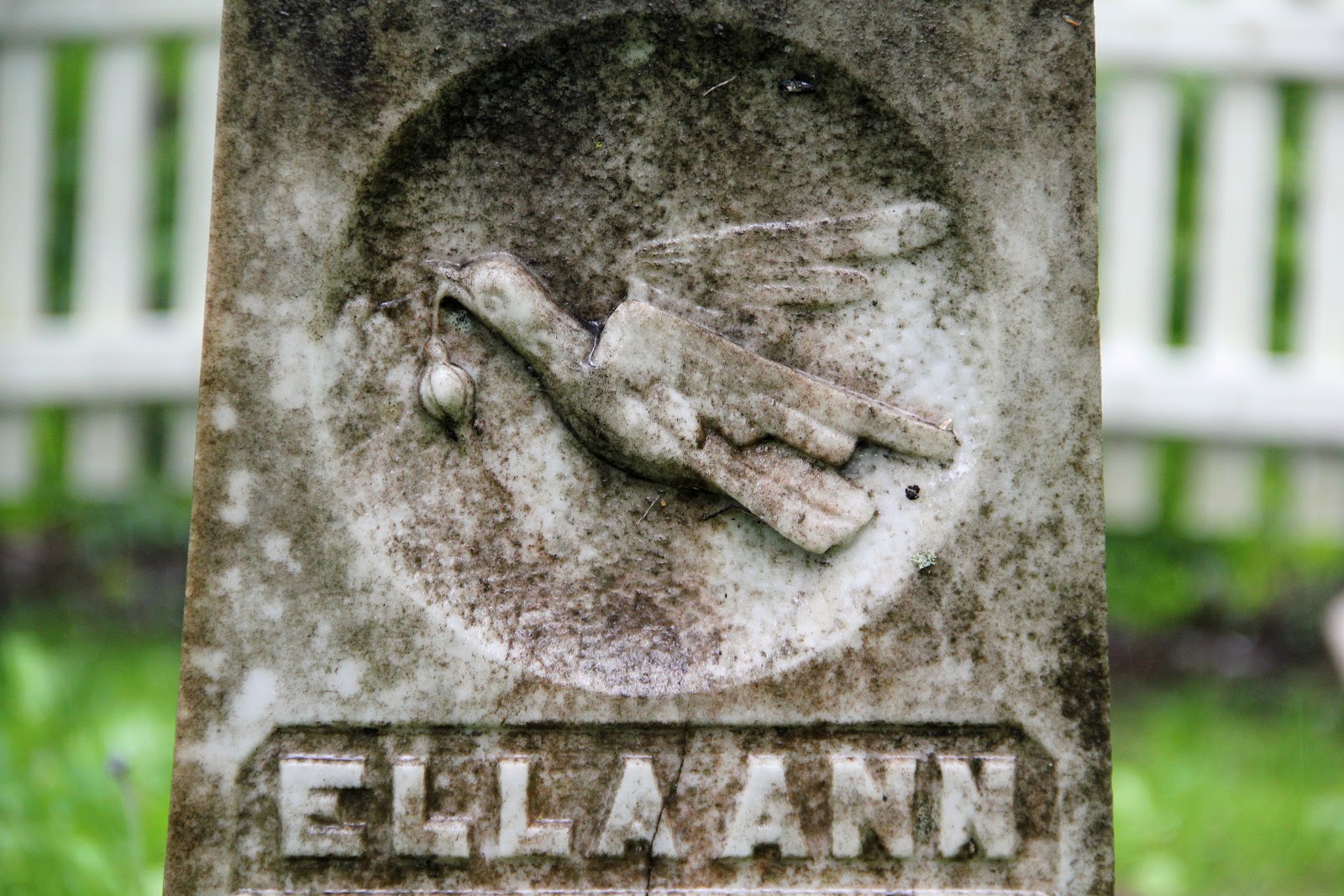
    Notice the dove with a rose bud in it's beak, this too is symbolic of the loss of a child.

    The dove and lamb images are frequently used to symbolize children.

    The rosebud adds an extra punch to this image.


    The stone on the left is found in Belfast, Maine, and sadly has long ago fallen over. Notice the hand of the angel. She carries a rosebud back to Heaven with her. Very subtle how the rosebud was worked into this image.

    Breathtaking!

    Once the personal information is read on the stone, we realize this is a child of less than 2 years of age and the only child to her grieving parents.

    As an icon, the rose speaks to us in many ways. This quote may say it all...


    "Man is harder than iron, stronger than stone and more fragile than a rose."  -Turkish Proverb


    Wednesday, May 30, 2012

    Reading Flora on stones

    One of my favorite parts of exploring a new cemetery is deciphering the icons on the stones. The stone above is a great example of the use of floral icons. 

    In the 1800's and into the early 1900's flora was used to convey personal messages, clues if you will, about the person buried there. This husband and wife stone is a fantastic example of that.


    I'll explain.

    First take George's side. His flora is the oak leaf. This is a pretty common symbol.

    The oak is a prized hard wood which grows slowly but is extremely sturdy. If you look very carefully you will also see acorns. This is a huge clue about George and his life.

    As I mentioned the oak grows slowly and takes a very long time before it produces any acorns. Therefore what this image tells us is that George lived a good long life and died at an older age. Couple that with the strength and virtue from the oak meaning. A picture of George begins to develop.

    How interesting to learn that a person lived to an old age just by the symbol on a stone. Now, lets look at the other side of the stone.

    Bessie's side also says a lot about who she was and how people saw her. One of the first things I noticed was the cross. This of course speaks to her faith. Wrapped around the cross is ivy. This is an important floral icon and deepens the meaning of the cross.

    Ivy is one of the few plants that can remain green even when it's subjected to harsh conditions. You can freeze ivy and it will withstand.

    This makes it a symbol of immortality as well as faith and fidelity (since it's color remains true). Faith to the church, and no doubt, to her husband as well.

    In addition to never changing it's color, ivy also clings to things. It climbs and almost seems to support things as it grows. Therefore it is also seen as a symbol of friendship, attachment, affection and loyalty.

    Wow! See how that one plant has conveyed such a beautiful message to us about Bessie?

    There is one more plant mixed into her arrangement. It is the fern. Often ferns were pictured growing deep withing shaded forests. It is thought that to seek out a fern was a trek that only the most sincere would take. Even more meaning has now been added .What a fantastic compliment to the symbolism of the ivy. 

    I hope you enjoyed my translations. We will not meet George and Bessie, but somehow, I think I know a lot more about who they were.