Showing posts with label images. Show all posts

Thursday, August 8, 2013

How in the world did they come up with that? Military Edition

Have you ever wondered how some nicknames came about?  Why a delicate flower became the symbol of a very bloody conflict? Sometimes on the surface these things make no sense at all... until you hear the rest of the story. This blog will explain how certain military phrases, nicknames and symbols became part of our American consciousness.

Walking through most any American cemetery, one can see a collection of small metal markers near gravestones. These markers are meant to hold flags and typically reflect the symbols of the military branches and organizations that they represent.

Here I will explain a couple of the most seen.

World War 1 Marker depicting the “Poppy.” The red poppy has become a familiar emblem of Remembrance Day (November 11). Poppies bloomed in mass numbers across some of the worst battlefields of France during World War I. Their brilliant red color an appropriate symbol for the blood spilled in the war. Even today veterans groups can be found selling small paper "Buddy Poppies" to raise monies and awareness for their support programs.

There are many flowers in France... so why the poppy?

Doctor John McCrae, of Canada, serving as a military doctor is the reason.

It is believed that the death of Dr. McCrae's friend, Alexis Helmer, was the inspiration for McCrae's poem ‘In Flanders Fields’. The exact details of when the first draft was written may never be known because there are various accounts by those who were with McCrae at that time. Some say he wrote the poem in just 20 minutes in an effort to deal with his friends funeral, or that it was written on a work break in between groups of battlefield casualties.
    No matter HOW the poem came about... the fact that it was a highly emotional poem written right on the battlefield, greatly impacted all who read it. The imagery in the poem  'In Flanders Fields'  became the symbol of the War....


    In Flanders fields the poppies blow                                        
    Between the crosses, row on row,
    That mark our place; and in the sky
    The larks, still bravely singing, fly
    Scarce heard amid the guns below.

    We are the Dead. Short days ago
    We lived, felt dawn, saw sunset glow,
    Loved and were loved, and now we lie
             In Flanders fields.

    Take up our quarrel with the foe:
    To you from failing hands we throw
    The torch; be yours to hold it high.
    If ye break faith with us who die
    We shall not sleep, though poppies grow
             In Flanders fields.


    WWI also brought the term "Doughboy" into the American lexicon.


    Doughboys' was the nickname given to the American Expeditionary Force that took part in the later years of World War One. Before this decisive US involvement the name had applied only to infantryman, but at some point between April 1917 and November 1918 the word expanded to include the whole American armed forces. The term was not used in a derogatory sense, in fact it was a badge of honor, and is present in the diaries and letters of US serviceman, as well as newspapers.

    The actual origin of the term 'Doughboy' is still debated within both US historical and military circles, but it dates back to at least the American-Mexican War of 1846-7 after observers noticed U.S. infantry forces were constantly covered with chalky dust from marching through the dry terrain of northern Mexico, giving the men the appearance of unbaked dough. Another suggestion also arises from the Mexican–American War, and the dust-covered infantry men resembled the commonly used mud bricks of the area known as adobes. No one knows for sure the exact inspiration for the nickname but the fact remains that it was made very popular many years later during WWI. 

    Click on the link below to hear a hit song from the era using the term.
    Johnny Doughboy Found a Rose in Ireland

    Another strange nickname comes from WWII.

     "The Ruptured Duck" marker was originally  a cloth insignia depicting an eagle inside a wreath. WWII servicemen and women wore it on uniforms above the right breast pocket.

    It was issued to service personnel who were about to leave the military with an Honorable Discharge. It also allowed them to continue to wear their uniform for up to thirty days after they were discharged since there was a clothing shortage at that time. This showed the MP's that they were in transit and not AWOL. 


    Well, the boys thought the eagle looked more like a duck; and because it meant they were going home, the popular saying was, 

    "They took off like a Ruptured Duck"

    Kind of paints a funny picture, huh? But that's the true story. Ask any WWII veteran, they know the term well. 
    Written by guest blogger:  Daniel Meehan


    Tuesday, June 26, 2012

    the Siren's song


    Siren Song  n. An enticing plea or appeal, especially one that is deceptively alluring.


    The Cemetery and Mythology... not a combination one sees very frequently. That's why I was pretty excited to find the image above.

    This is the stone was dated 1849 and belonged to a 53 yr old man. The cemetery is on the Coast of Maine and holds countless ship captains. There are images of anchors and boats of all kinds on various stones here. Stories of bravery and tragedy.


    Could this be a grieving wife.... yes. It may even be the classic image of the Virtue - Faith.

    But, this imagery makes me think it could be even more than that. The parted curtain symbolizes the entry into Heaven. The anchor, a strong symbol of a life on the Sea as well as that of Christian faith. The finger pointed upwards, yet another sign of the final reward.

    Then there is the woman herself. The first thing that struck me was her long Lady Godiva style hair. A long flowing dress with what looks like bare arms.

    This would have been irresistible imagery in the mid 19'th century. Is she not a wife but a temptress maybe?


    So what exactly is a Siren?


    Sirens were dangerous creatures who lured mariners with their beautiful music and enchanting voices to an untimely death.

    They were considered the daughters of the river god Achelous. There were said to be between 2 and 5 of them existing off the islands of Greece. There are two Sirens referred to in Homer's tale the Odyssey. As well as more references in the Iliad.

    Though these creatures are tied to the Sea, they are not sea maidens and are not to be confused with mermaids. In fact they are not fish-like at all.

    The earliest Greek images portraying Sirens showed them as large birds with female faces. They sang like birds and were granted wings by Demeter.


    This pottery portrays an interesting legend. 

    It is said that Odysseus was curious as to what the Sirens sung in their song to him, so, on Circe's advice, he had all his sailors plug their ears with beeswax and tie him to the mast. He ordered his men to leave him tied tightly to the mast, no matter how much he would beg. When he heard their beautiful song, he ordered the sailors to untie him but they bound him tighter. When they had passed out of earshot, only then was Odysseus untied.


    The depictions of Sirens have changed over time as they became less bird like and portrayed more as femmes fatales.

    There have even been references to them as the muses of the underworld.

    Descriptions are also found of them on the islands, "lolling there in their meadow, round them heaps of corpses rotting away, rags of skin shriveling on their bones."  Not your average maiden.


    With all of the death in the 19'th century by men making their fortunes from the Sea, it is no wonder the legend of the Siren may still be found in the cemetery. Though it's origins are Greek, the Siren appears any place in the world where people feared for their lives and the unknown.  Even in a small cemetery off the coast of Maine.


    Thursday, May 31, 2012

    the Rose

    Is there any other flower so prized for it's beauty?  No wonder the rose is a favorite as a floral icon on graves.  The Victorians used the rose in it's different colors as a language all it's own. 
    This was known as Floriography. 

    To express your love, you would gives roses that were red. A yellow rose on the other hand simply conveyed  friendship.  


    An eloquent epitaph
    In the cemetery, the most common use of the Rose as an icon is to convey beauty.

    I really like the personal epitaph on this grave in Brunswick, ME.

    "I love roses, I love pretty things." -Dorothy

    Sheer eloquence in it's simple truth.

    The rose can be used to convey literal beauty. A husband may use the rose on his wife's grave, speaking to her physical beauty.  

    It can also be used figuratively. To convey that a person was beautiful to those around them. Beauty from within, if you will.

    The rosebud- always a sad symbol of loss

    There is another way that the rose is used as a symbol. 


    Look at the development of the flower itself. If a rose is portrayed as a bud, it always symbolizes the life of a child.


    The rose bud has not had time to fully bloom. Just as the babe was taken too soon.


    Additionally the bud is often shown as snapped off at the stem. The photo below is a wonderful example of this. The grave is that of a young boy, showing us that the rose symbol was used for both boys and girls.

    The snapped rosebud


    Look carefully, you may see roses tucked into other imagery.  


    The stone to the right is a small obelisk.
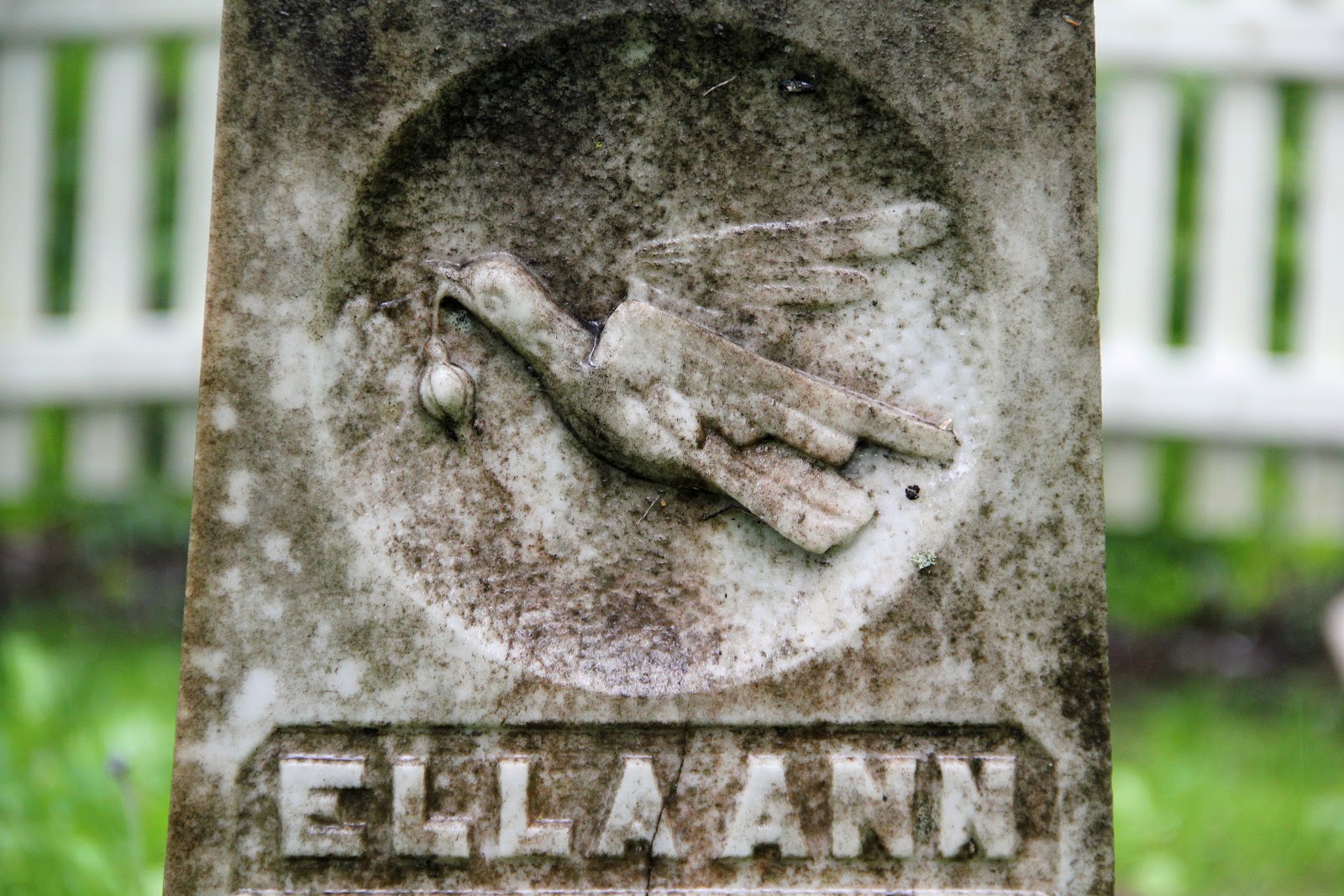
    Notice the dove with a rose bud in it's beak, this too is symbolic of the loss of a child.

    The dove and lamb images are frequently used to symbolize children.

    The rosebud adds an extra punch to this image.


    The stone on the left is found in Belfast, Maine, and sadly has long ago fallen over. Notice the hand of the angel. She carries a rosebud back to Heaven with her. Very subtle how the rosebud was worked into this image.

    Breathtaking!

    Once the personal information is read on the stone, we realize this is a child of less than 2 years of age and the only child to her grieving parents.

    As an icon, the rose speaks to us in many ways. This quote may say it all...


    "Man is harder than iron, stronger than stone and more fragile than a rose."  -Turkish Proverb


    Wednesday, May 30, 2012

    Reading Flora on stones

    One of my favorite parts of exploring a new cemetery is deciphering the icons on the stones. The stone above is a great example of the use of floral icons. 

    In the 1800's and into the early 1900's flora was used to convey personal messages, clues if you will, about the person buried there. This husband and wife stone is a fantastic example of that.


    I'll explain.

    First take George's side. His flora is the oak leaf. This is a pretty common symbol.

    The oak is a prized hard wood which grows slowly but is extremely sturdy. If you look very carefully you will also see acorns. This is a huge clue about George and his life.

    As I mentioned the oak grows slowly and takes a very long time before it produces any acorns. Therefore what this image tells us is that George lived a good long life and died at an older age. Couple that with the strength and virtue from the oak meaning. A picture of George begins to develop.

    How interesting to learn that a person lived to an old age just by the symbol on a stone. Now, lets look at the other side of the stone.

    Bessie's side also says a lot about who she was and how people saw her. One of the first things I noticed was the cross. This of course speaks to her faith. Wrapped around the cross is ivy. This is an important floral icon and deepens the meaning of the cross.

    Ivy is one of the few plants that can remain green even when it's subjected to harsh conditions. You can freeze ivy and it will withstand.

    This makes it a symbol of immortality as well as faith and fidelity (since it's color remains true). Faith to the church, and no doubt, to her husband as well.

    In addition to never changing it's color, ivy also clings to things. It climbs and almost seems to support things as it grows. Therefore it is also seen as a symbol of friendship, attachment, affection and loyalty.

    Wow! See how that one plant has conveyed such a beautiful message to us about Bessie?

    There is one more plant mixed into her arrangement. It is the fern. Often ferns were pictured growing deep withing shaded forests. It is thought that to seek out a fern was a trek that only the most sincere would take. Even more meaning has now been added .What a fantastic compliment to the symbolism of the ivy. 

    I hope you enjoyed my translations. We will not meet George and Bessie, but somehow, I think I know a lot more about who they were.