Showing posts with label Windy Keith. Show all posts

Monday, September 9, 2013

How the Civil War taught us to deal with the business of death.

The American Civil War was a brutal war but it brought on great awareness of how to handle and bury our war hero’s.

The government for both the North and South saw the coming conflict as a war that would not last much more then 90 days. A grave underestimate all around, they would soon would find out that the war would continue with unfathomable loss of life. Neither side was prepared for the numbers of dead that they would suffer.

There was absolutely no structure in place on how to identify or how to handle thousands of dead soldiers.

After word of a battle, whole communities went on a quest for information on who may have become a casualty. With no responsibility on either side for notifying the next of kin, newspapers from both north and south published long lists of the dead after every major engagement, taken from official military reports - which were not always accurate. So people went missing; people went buried unidentified or miss identified and the missing in action disappeared.
Zouave ambulance crews remove the wounded from a battlefield.


Imagine your loved one being 18 years old, he leaves for war, far from home. You later read your sons name in the newspaper as dead. Or maybe you receive a letter from one of his comrades explaining that your son has died and he was buried in a shallow grave or worse, a mass grave upon the battlefield...


Now it is up to you to either let him rest eternally there, to make the trip to yourself to locate his remains, or to possibly pay someone to locate the remains, retrieve them, and hope the that body is successfully shipped back home to you.


One of the major problems was trying to trying to identify the thousands of bodies after a battle since dog tags had not been issued yet. Many men were reported as missing presumed dead only later to be found wounded in a hospital or in a prison after being taken a prisoner of war. It was the responsibility of the  field commanders for identification and burial efforts. However, these efforts were not well organized or executed, and were often given low priority. 

A privately purchased Civil War ID tag


In order to help them go home if they became a casualty, men would soon start pinning their names inside their coats and some would buy a brass tag from a sutler with their name, regiment and state stamped onto it to. These were not government issued to soldiers. Modern forms of soldier identification, i.e. dog tags would not come about until WWI.


 If you could afford shipping the body home you then would be challenged on how to preserve the remains in order to hold a viewing. Bodies were sometimes packed in ice or just shipped in a pine coffins. Nurses would sometimes gather flowers to be placed within the coffin to mask the stench of the decaying remains. Occasionally the people who were hired to locate and ship the remains home would lie about finding the remains and have stones placed within the coffin. This would simulate the weight of a body and ensure a payment for their "efforts". It would be a terrible shock to the family if they decided to get one last look at their loved ones. 

Embalming, which was used to preserve for medical studies, would soon be used to preserve remains for shipping... for a price. Thomas Holmes who pitched himself as the father of embalming and was given the rank of captain in
the U.S. Army Medical Corps would charge $50 for an officer and $25 for an enlisted man. As the war continued and embalmers were in high demand, those figures rose to $80 and $30, respectively. Feeling he could make even more money if he worked in the private sector performing the same duties, Holmes resigned his commission and began to charge $100 per embalming.

As surgeons and pharmacists became aware of the profits to be made from embalming, they traded in their instruments for those of embalmers and followed the troops into war. After the battle, the embalmers would converge on the scene and quickly find dead officers to embalm, knowing that the family of an officer would be grateful and able to pay the fee. One embalming company went so far as to try to obtain a government contract to embalm all Federal dead. A bill was introduced to allow the creation of a corps of military undertakers for each division, but it was never passed.


To market embalming, a Washington embalmer showcased an embalmed soldier in a display window for days.

Richard Burr, a Union surgeon who served with the 72nd Pennsylvania Volunteer Infantry, became an embalming surgeon when he saw the profit to be made. Known for severely inflating the price of embalming services, he created and distributed handbills after the battle of Anita offering “Embalming for the Dead.” The handbills invited the curious to watch the procedure.

Some remains were sent to the wrong families who were shocked when they opened the wooden coffins to find out that it wasn't their loved ones inside...

One such story "The Stranger" comes from Gray, Maine:

Upon hearing of the death of their loved one the family of Lt. Charles H. Colley, Co. B., 10th Maine Vol. paid the government for embalming and transportation of the remains. When his body arrived they opened the casket in farewell. Instead of their son, they found a fully uniformed Confederate soldier. They were grief stricken but finally decided to bury the lad in a Gray Cemetery. That no ill will was borne the soldier was evidenced by the erection of a tombstone over his grave shortly after. Inscribed on the slab was, "Stranger-a soldier of the late war. Erected by the Ladies of Gray." No one knows for sure how the mistake was made. Lt. Colley's body arrived shortly after. He is buried about 100 feet southwesterly from the Stranger. Local historians guess that both Lt. Colley and the Confederate might have been wounded in the same battle, hospitalized together and both must have died about the same time. And there's always the possibility that the Confederate soldier may have been named Colley. Similarity in names could have accounted for the error.

With the awareness of the amount of bodies needing burial Congress approved the purchase of land in 1862, twelve military cemeteries located on or near major battlefields, Union camps and hospitals, and other military sites were authorized. Most of them, including Robert E. Lee's estate, which became Arlington Cemetery, were on Southern soil. In the midst of the war and in the immediate aftermath these cemeteries made profoundly political statements about Northern power, resources, and determination.

 The sheer numbers of those needing gravestones also altered the way in which we carved final memorials in general... but that, as they say, is the stuff for yet another blog.


Thank You to 
Daniel Meehan,

Civil War Historian 
and Reenactor,
for sharing his vast knowledge and expertise on this topic.

Tuesday, August 20, 2013

the Claddagh


It's rare, but occasionally I stumble across this icon on a grave stone. It has to be one of the most romantic images I know of.  It's a symbol of love created in the small Galway fishing village of Claddagh. The word “Claddagh” comes from the Irish term An Cladach, meaning a flat, stony shore.


The parts of the symbol are broken down as so,
Two hands (friendship) cradling a heart (love) topped by a crown (loyalty).

Legends behind the claddagh are many but one stands out as a triumph of the power that true love can hold...

Richard Joyce, a native of the small fishing village, was captured by Algerian pirates and sold as a slave to a Moorish goldsmith. When William III of England demanded the release of all British subjects, Joyce, too, was released. Not wanting to lose a valuable and skilled apprentice, the Moorish goldsmith offered Joyce a major portion of his wealth and his daughter in marriage, if Joyce would stay on in Algiers. Joyce refused the tempting offer and returned to the village of Claddagh where he had left behind the woman he loved. Some legends say that each day Joyce took a tiny bit of gold and saved it till he had enough to form a ring. Other accounts say he designed the symbol upon his return to Ireland. Either way, the ring he made stood for eternal love and was given, with his heart, to the woman who waited for him at home.

How to wear the Claddagh


If the ring is worn on the right hand with the crown facing out ward, the heart is available and looking for love.
  If the crown is turned to face the wearer... love has been found and is being considered.

Once the ring has been transferred to the left hand, love has become eternal.


To find the Claddagh on a gravestone speaks to the love a couple shared in life and their promise to each other that not even death can take it from them.  

Seriously... is that romantic or what?

Thursday, August 8, 2013

How in the world did they come up with that? Military Edition

Have you ever wondered how some nicknames came about?  Why a delicate flower became the symbol of a very bloody conflict? Sometimes on the surface these things make no sense at all... until you hear the rest of the story. This blog will explain how certain military phrases, nicknames and symbols became part of our American consciousness.

Walking through most any American cemetery, one can see a collection of small metal markers near gravestones. These markers are meant to hold flags and typically reflect the symbols of the military branches and organizations that they represent.

Here I will explain a couple of the most seen.

World War 1 Marker depicting the “Poppy.” The red poppy has become a familiar emblem of Remembrance Day (November 11). Poppies bloomed in mass numbers across some of the worst battlefields of France during World War I. Their brilliant red color an appropriate symbol for the blood spilled in the war. Even today veterans groups can be found selling small paper "Buddy Poppies" to raise monies and awareness for their support programs.

There are many flowers in France... so why the poppy?

Doctor John McCrae, of Canada, serving as a military doctor is the reason.

It is believed that the death of Dr. McCrae's friend, Alexis Helmer, was the inspiration for McCrae's poem ‘In Flanders Fields’. The exact details of when the first draft was written may never be known because there are various accounts by those who were with McCrae at that time. Some say he wrote the poem in just 20 minutes in an effort to deal with his friends funeral, or that it was written on a work break in between groups of battlefield casualties.
    No matter HOW the poem came about... the fact that it was a highly emotional poem written right on the battlefield, greatly impacted all who read it. The imagery in the poem  'In Flanders Fields'  became the symbol of the War....


    In Flanders fields the poppies blow                                        
    Between the crosses, row on row,
    That mark our place; and in the sky
    The larks, still bravely singing, fly
    Scarce heard amid the guns below.

    We are the Dead. Short days ago
    We lived, felt dawn, saw sunset glow,
    Loved and were loved, and now we lie
             In Flanders fields.

    Take up our quarrel with the foe:
    To you from failing hands we throw
    The torch; be yours to hold it high.
    If ye break faith with us who die
    We shall not sleep, though poppies grow
             In Flanders fields.


    WWI also brought the term "Doughboy" into the American lexicon.


    Doughboys' was the nickname given to the American Expeditionary Force that took part in the later years of World War One. Before this decisive US involvement the name had applied only to infantryman, but at some point between April 1917 and November 1918 the word expanded to include the whole American armed forces. The term was not used in a derogatory sense, in fact it was a badge of honor, and is present in the diaries and letters of US serviceman, as well as newspapers.

    The actual origin of the term 'Doughboy' is still debated within both US historical and military circles, but it dates back to at least the American-Mexican War of 1846-7 after observers noticed U.S. infantry forces were constantly covered with chalky dust from marching through the dry terrain of northern Mexico, giving the men the appearance of unbaked dough. Another suggestion also arises from the Mexican–American War, and the dust-covered infantry men resembled the commonly used mud bricks of the area known as adobes. No one knows for sure the exact inspiration for the nickname but the fact remains that it was made very popular many years later during WWI. 

    Click on the link below to hear a hit song from the era using the term.
    Johnny Doughboy Found a Rose in Ireland

    Another strange nickname comes from WWII.

     "The Ruptured Duck" marker was originally  a cloth insignia depicting an eagle inside a wreath. WWII servicemen and women wore it on uniforms above the right breast pocket.

    It was issued to service personnel who were about to leave the military with an Honorable Discharge. It also allowed them to continue to wear their uniform for up to thirty days after they were discharged since there was a clothing shortage at that time. This showed the MP's that they were in transit and not AWOL. 


    Well, the boys thought the eagle looked more like a duck; and because it meant they were going home, the popular saying was, 

    "They took off like a Ruptured Duck"

    Kind of paints a funny picture, huh? But that's the true story. Ask any WWII veteran, they know the term well. 
    Written by guest blogger:  Daniel Meehan


    Tuesday, August 6, 2013

    Thyme, the herb of Death


    While walking through a very old garden cemetery, I happened to noticed for the first time, a very steep embankment that was covered in something that was clearly not grass. Little purple blossoms were peeking out here and there in bunches within the massive green carpet of the stuff. My friend who is an avid landscaper told me to pick a bit of the green ground cover and crush it between my fingers.

    Instantly I recognized the pungent aroma from stews and stuffings that I have made countless times in my own kitchen. There was no doubt, it was Thyme. 


    She told me that thyme was a common plant to be found growing unchecked in the oldest of cemeteries. THIS fact, I had never heard of. I was intrigued. She went on to tell me that this fragrant little herb was commonly planted in cemeteries of antiquity to mask.... well, odours.

    I had to know more about this so I did a little research and was shocked at the many uses of thyme and it's long and close association with death.


    Wild or creeping thyme or Thymus Serpyllum, a species of the mint family, has been used in death practices and various rituals all the way back to Ancient Egypt. The Egyptians used thyme in their embalming practices. The Greeks burnt thyme as an incense in their temples, believing it to be a source of courage. Roman soldiers, who may be away from home for long periods of time, slept on the herb to help them with melancholy.

    The practice of sleeping on thyme can also be found in the Middle Ages when Europeans used sprigs of thyme under their pillows to ward off nightmares.


    Teas made of thyme were promised to relieve ailments such as headaches and hangovers.

    It was also encouraged to plant thyme for the bees as it was said to fortify them.


    Patches of thyme were even set aside by gardeners who thought them to be inhabited by fairies.


     Due to it's fragrant aroma, thyme along with lavender, was sprinkled on the floors of churches to purify the air. For those of you who aren't aware... long ago, people were once buried under the floors of churches and well, with no Lysol around. You get the picture.

    Thyme has been burnt as a purifying incense for as long as sage has.  It has also long been placed into coffins during funerals. This practice was thought to help insure the departed one's passage into the next life.

    Members of the Fraternal Order of Odd fellows carry sprigs of thyme during their funeral rites. They ceremonially throw the herb into the open grave of their passed members.

     The practice of planting creeping thyme in cemeteries can be found beginning in Wales. This made sense to me since I realized that some of the earliest slate stones in New England were imported on ships from Wales. The Island of Wales has long been known for it's thriving slate industry. My mind made the instant connection, if settlers were bringing over stones the knew well for carving, maybe they were bringing other bits of cemetery tradition with them as well... fragrant, spreading thyme plants

    Some British citizens hold to an age old death superstition dealing with thyme... 


    It is thought that bringing thyme sprigs into a house will also bring death or illness to a family member within that house.

     Thyme is also said to be a phantom scent common with haunted locations.

    Today, thyme may be a common herb found in the household spice rack but this noble herb has quite an interesting list of uncommon uses and a mystical, almost magical wealth of folklore attached to it.


    Thursday, July 25, 2013

    the Long S


    Have you ever walked through a very old cemetery and become confused as to what a stone was trying to say? Or looked at an epitaph and wondered why in the world a letter -f- was used in place of an -s-?  If so, you have witnessed first hand the confusing use of the long s.

    The word pass appears as pafs and wise looks like the word wife.

    For years I have wondered about this character in Colonial script. Why did they use this -f- letter... and what were the rules dictating it's use? Some words had it, others didn't... some words that contained double -s- had both the -f- like letter and a normal -s-.  I asked teachers and historians alike but with no suitable answer to my question. Everyone had the same answer... "I'm not sure."

    The problem was... neither were the Colonists who etched it into their memorials and that's the reason it's not used today.


    Let me explain:

    What you are looking at is referred to as the long, medial or descending letter s represented by what looks like a lower case f.

    The true lower case s we are accustomed to using today is referred to as the short, round or terminal s.

    From here on I will make reference to long and short s forms.

    The long s came from early Roman cursive. After dying out, it was picked up again in usage sometime in 1400's by Italian printers. It was quite a fashionable trend. The long s also came in 2 forms, with and without a nub. When appearing, the nub is always placed to the left of the letter.

    It wasn't used exclusively by the Italians though, the Germans also used this character in Blackletter typeface.

    Here are some of the complicated rules on how to use this letter:


    When a font containing long s is used, German typographic rules require the short s to be used when it occurs singly at the end of a syllable, while long s is used at the beginning of a syllable.  The short s appears at the end of each word within a compound word. This is why some call it the terminal s - it comes at the end. Where as the long s comes in the middle and is sometimes called medial s.

    Confused yet? 
    Yes, and so were most people!
     
    These rules were broken all the time.

     Notice the last two pictures on the left. They belong to a husband and wife, both were carved within about 10 years of each other. Sarah's stone makes reference to her husband - Joseph - using a short s. While on Mr. Belknap's stone his name is spelled out with a longs s. Same name two different usages of the s.


      The use of any typeface using the long s fell out of favor in the US and Britain within the early 19'th century about 1810, although handwritten samples can be found into the 1860's. It is said that confusion and even those suffering from poor vision, all led to the demise of this font trend. In a population that wasn't terribly literate, it was just too complicated.


    Today those who use the long s do so to catch the eye only.  It's modern use is as buried as the Colonials who so long ago etched it into stone.


    Wednesday, July 10, 2013

    Taphophile Corner - Displaced Honor


    Over the years as I make my way through cemeteries gathering Civil War veterans burial information, I have noticed a common occurrence, one of misplaced GAR flag markers. 


    The GAR (Grand Army of the Republic) was an organization much like today’s American Legion and was made up of honorably discharged Union Veterans, not every veteran joined the GAR but those who were members would receive a flag holder for their grave so a flag could be placed for Decoration Day.

    But as I make my way across states and cemeteries I see the same theme, that of these markers on the wrong graves, such as a child’s grave, that of a woman, on a man’s grave who was not even born during the Civil War and even propped up near a fence. 
    Women were not permitted to be G.A.R. members

    I have had the chance to talk to some cemetery groundskeepers who have told me that the markers are moved a lot of times so they can mow around a stone and then either forgotten about or misplaced.

     A person whose relative who fought in WWII needed a flag holder and this GAR marker on a grave seemed like a good holder, and even some cemeteries will help a person remove the marker to place elsewhere. 


    The reasons are many of why they are removed and still some are removed and sold on Ebay,  

    which is against Ebay policies. In some states it is against the law to even sell these.


    One day I walked into a cemetery office and asked about the misplaced markers. I was told that they had no idea of what to do and for me to just fix it if I like…WHAT!!! Ok, so I can just remove any grave marker??? I know there were laws protecting grave markers. What about cemetery rules??? 

    Born after the Civil War - could not have earned a G.A.R. marker

    Before removing a marker you need permission from the cemetery commission and from a relative of the person whose grave it is on. That can take a long time and research.


    But I am starting to notice that this trend is now not being limited to just the GAR markers but is also effecting other veterans from other wars. It is sad that these men and woman who gave so much and asked so little can not even keep a simple flag holding to honor them, just because someone is too lazy to buy their own or to replace it correctly after mowing.

    One day I was talking with a member of an American Legion and he asked me to ID an item. He showed me a GAR Marker, I explained to him what it was and the organization. He told me that the Legion Post had a 55-gallon barrel full of them and they were going to scrap them because they didn’t know what they were. I took them all and have since replaced them back into their local cemetery.


     I am a believer also that the correct marker should be placed at the correct grave, GAR or Civil War Vet for Civil War Veterans, Span Am for Spanish American Veterans, WWII Markers for WWII Vets.


    I have been seeing VFW Markers for Civil War Veterans and this is a miss representation as there were no VFW’s around at that time and if you want to spend the time marking graves then it should be done with the right marker. 


    A special Thank You to Daniel Meehan my guest blogger. 

    Daniel has spent countless hours in the cemeteries of New Hampshire documenting Veteran's graves and compiling their photos and histories. Daniel is a War reinactor as well as a Veteran advocate. He was intricately involved in the moving and honorable re-interment of a Civil War Veteran and his family due to a construction project in his area. Daniel personally provides the flags to various cemeteries in his town since the VFW has refused to do so. He feels passionately about honoring the service of Veterans across the board and I believe, was the perfect person to speak on this topic.

    Tuesday, June 26, 2012

    the Siren's song


    Siren Song  n. An enticing plea or appeal, especially one that is deceptively alluring.


    The Cemetery and Mythology... not a combination one sees very frequently. That's why I was pretty excited to find the image above.

    This is the stone was dated 1849 and belonged to a 53 yr old man. The cemetery is on the Coast of Maine and holds countless ship captains. There are images of anchors and boats of all kinds on various stones here. Stories of bravery and tragedy.


    Could this be a grieving wife.... yes. It may even be the classic image of the Virtue - Faith.

    But, this imagery makes me think it could be even more than that. The parted curtain symbolizes the entry into Heaven. The anchor, a strong symbol of a life on the Sea as well as that of Christian faith. The finger pointed upwards, yet another sign of the final reward.

    Then there is the woman herself. The first thing that struck me was her long Lady Godiva style hair. A long flowing dress with what looks like bare arms.

    This would have been irresistible imagery in the mid 19'th century. Is she not a wife but a temptress maybe?


    So what exactly is a Siren?


    Sirens were dangerous creatures who lured mariners with their beautiful music and enchanting voices to an untimely death.

    They were considered the daughters of the river god Achelous. There were said to be between 2 and 5 of them existing off the islands of Greece. There are two Sirens referred to in Homer's tale the Odyssey. As well as more references in the Iliad.

    Though these creatures are tied to the Sea, they are not sea maidens and are not to be confused with mermaids. In fact they are not fish-like at all.

    The earliest Greek images portraying Sirens showed them as large birds with female faces. They sang like birds and were granted wings by Demeter.


    This pottery portrays an interesting legend. 

    It is said that Odysseus was curious as to what the Sirens sung in their song to him, so, on Circe's advice, he had all his sailors plug their ears with beeswax and tie him to the mast. He ordered his men to leave him tied tightly to the mast, no matter how much he would beg. When he heard their beautiful song, he ordered the sailors to untie him but they bound him tighter. When they had passed out of earshot, only then was Odysseus untied.


    The depictions of Sirens have changed over time as they became less bird like and portrayed more as femmes fatales.

    There have even been references to them as the muses of the underworld.

    Descriptions are also found of them on the islands, "lolling there in their meadow, round them heaps of corpses rotting away, rags of skin shriveling on their bones."  Not your average maiden.


    With all of the death in the 19'th century by men making their fortunes from the Sea, it is no wonder the legend of the Siren may still be found in the cemetery. Though it's origins are Greek, the Siren appears any place in the world where people feared for their lives and the unknown.  Even in a small cemetery off the coast of Maine.


    Monday, June 18, 2012

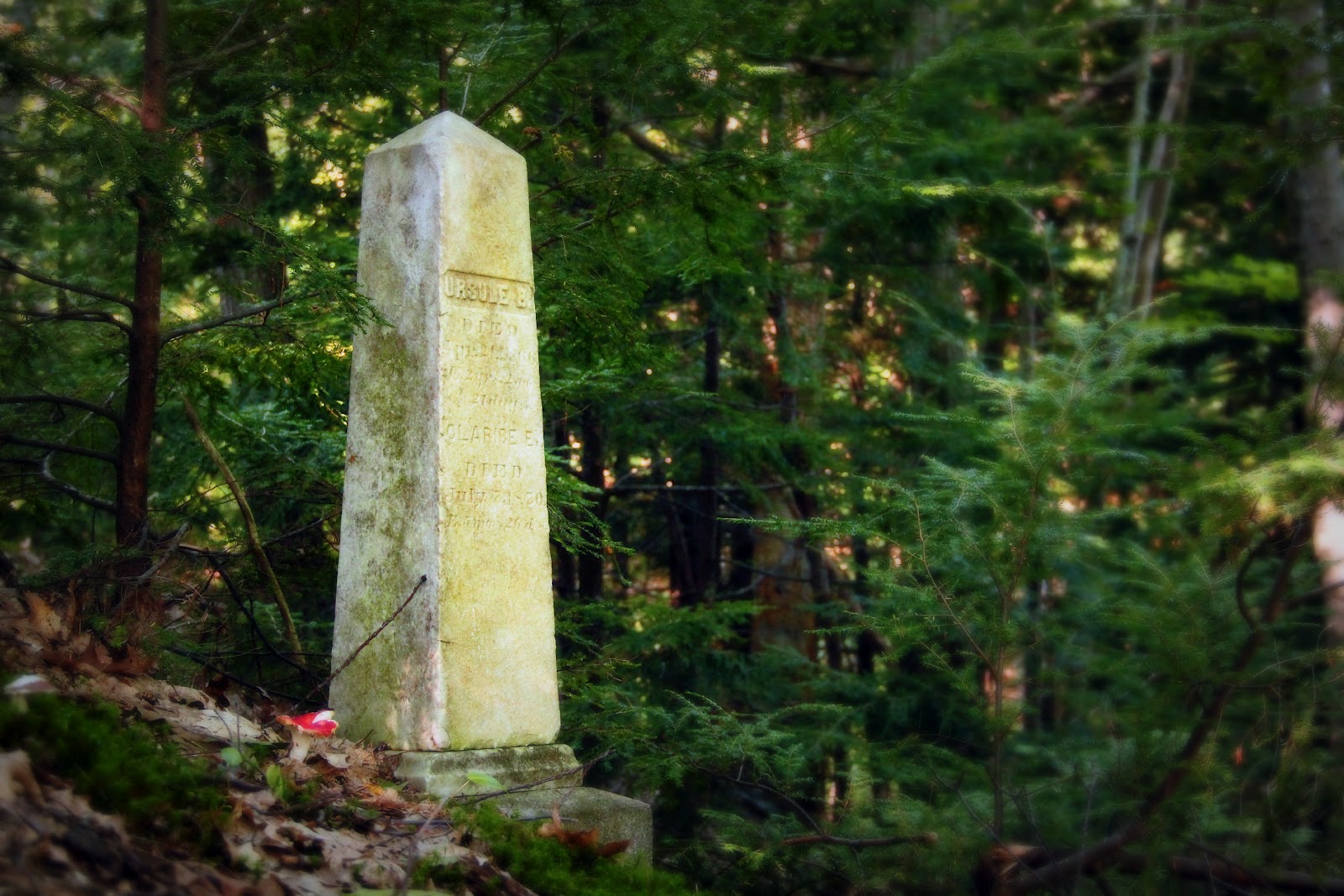
    the Obelisk


    The obelisk is one of the most classic shapes in the cemetery. But did you ever wonder what inspired it's design?

    Say obelisk and no doubt the Washington Monument in our Nation's capital comes to your mind. It's one of the most famous obelisks in the world. But this shape is also found everywhere in 19'th century cemeteries. Shapes are important in cemetery art... design always has meaning.

    The answer can be found in Egypt.


    The Egyptians were absolute masters in forming monuments and statues that would stand the test of time. Monuments dedicated to Pharaoh were commonly portrayed as sitting. All arms and legs were carved compactly situated to the bodies. Over the ages, there were no long outreaching arms to break off unlike many Greek statues. The compact Egyptian design held up beautifully over time. They truly mastered shapes that were meant to hold up.

    A main deity in the Egyptian religious beliefs, was the sun god Ra. Life was seen to come from Ra but death was also connected. The dead were buried on the west side of the Nile where the sun was seen as dying each day. On the flip side, the living stayed strictly on the east side of the Nile... here the sun was daily reborn.

    The obelisk shape is said to symbolize a ray of light, associated with Ra.  Also known as a light pillar or solar pillar. It's four cornered base is solid and thicker than it's top, allowing it to withstand more than a simple pillar. A light pillar is a visual phenomenon created by the reflection of light from ice crystals with near horizontal parallel planar surfaces. The light can come from the Sun (usually at or low to the horizon) in which case the phenomenon is called a sun pillar. It can also come from the Moon or other sources such as streetlights.


    Did you know that the obsession that fueled the obelisk movement in America had a name?

    The term "Egyptomania" was coined in part due to ... Napoleon?

    Yes, we have Napoleon to thank for introducing America to the "All-Things-Egyptian Craze".  Napoleon's Egyptian Campaign from 1798-1801 introduced the world to Egypt and it's culture. In the early 1800's books were being published on Egypt and the fever began to spread rapidly. There wasn't a single piece of American culture that wasn't suddenly influenced by this new trend. This was seen especially in the cemetery.

    After some time the obelisk also began to take on some variations. As we see in this photo to the side, they didn't always have a simple pyramid top. Some were topped with urns.

    The urns are also of Egyptian origin - (the canopic jar)

    Some had small angular roof peaks. We call these vaulted obelisks.

    While others had crosses attached to the tops.


    Even traditionally shaped stones, like this slate, added the obelisk image .


    This truly massive obelisk towers at more than 30 feet high. A grand representation to a family's wealth and social status.


    Some obelisks incorporated other traditional icons such as the classic willow or maybe a dove indicating a lost child. Multiple layers of meaning...


    Hope you enjoyed this post and explanation.


    Tuesday, June 5, 2012

    Pointing Finger & Hand Stones

    "I am not afraid" - captions a finger pointing upwards.
    I want to take a moment to explain one of the most interesting and confusing icons of the cemetery.

    I have accumulated quite a collection of them over the years.

    The hand is a life symbol. When a finger is pointed upwards it is a message of faith. The person believes that, though the body has failed, the soul now continues upwards to Heaven.  Additionally on the stone above, the finger is seen pointing toward a broken chain, yet another life symbol. A link has been broken so the chain (or life) now ends. A statement of faith is added in "I am not afraid." For those of faith are said to never truly die.

    One question I am asked more than anything else seems to be...

    "If a finger pointed upwards means the person will go to Heaven, then what does a finger pointed downwards mean?"

    This question seems to really upset people. Like a Victorian equivalent to the Puritan Death Head in the scary department.

    The answer is very simple.

    This is the hand of God. 

    Man is not supposed to portray God as an image, it is blasphemy to do so. All we know about God's appearance is that Adam was made in his likeness.

    Since the Bible refers to the "hand of God" often,  it was then deemed appropriate to show just that much of God on stones, just a hand.

    This stone above is from Scarborough, Maine and it's one of the nicest I have found to demonstrate this point. Notice the heavenly clouds and radiating light? The finger also points to the Bible, again - a symbol of the faithful. This is such an amazing set of images!

    Sometimes the finger is seen pointing to additional icons. Like the finger at the top which pointed to the broken chain.

    This finger to the left, points to a heavenly star image.

    Take notice the sleeves on hand. The stone to the right has a fancy, full sleeve complete with lace. It belongs to someone's wife. 

    Another variation on the hand is the shaking hand. Looking at the sleeves is important on these images.

    Two masculine sleeves is a symbol of God grasping Man's hand and bringing him into Heaven.

    If one sleeve is feminine and the other masculine, it is seen as a matrimonial symbol. Husband and wife, one welcoming the other into Heaven.


    The final portrayal of the hand on a stone is that of hands clasped in prayer. Again, a symbol of a person's faith.


    Hope you enjoyed this explanation of the pointing finger and hand icons.

    Now, it's time to get out there and find a few of your own to share!

    If you'd like to share your images, you can post them on the Taphophile Corner Group Page on facebook. 

    https://www.facebook.com/groups/173533606049437/

    or follow me on twitter: @Taph_Corner